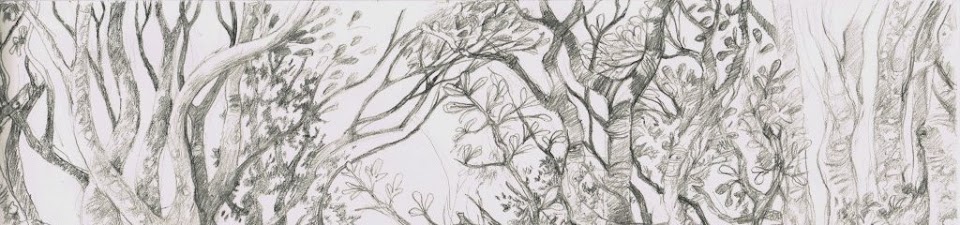
As we move towards dark moon, the shadow aspects this phase of the moon can bring forth are being felt in the collective, and for many of us on an individual basis. However, this is also the time for introspection and reassessment, dreaming up in the void. I've heard it said 'the Earth has had enough, and is sending us to our rooms to think it all over'.
This drawing epitomises where my focus has returned to over the last couple of weeks, and I'm not alone in this. I was inspired to draw it spending time with a lovely earth friend woman. With people's awareness turning to how food is sourced and transported, nursery's are having trouble keeping up, online seed companies have had to close their doors, and baby chickens are rare as hens teeth (pun intended, if somewhat bad taste). So, after an obsessive plant echo / ecodye phase, my garden called me back for some quality time spent together. This is one of the potential areas of awakening I see through the chaos, listening to, reconnecting with and hearing green folks, as sentient beings, also as both food and medicine...
In the dark of the womb we begin, as do these wee Capsicums, within the cauldron of the soil. Dark moon on into the first 2 weeks of the waxing moon, the Earth is exhaling, releasing moisture and nutrients to be absorbed. Time for planting annual seeds and seedlings, especially of which the foliage is the desired part of the plant. Creation births in darkness, followed by light, or as in seedlings case reaching for the light!
This is also when I begin tinctures of above ground parts, to be later decanted, all the funkier if on the full moon. I was keen to jar up Yarrow tincture and Elderberry Elixir, being the way things are, stocks were low. Juliette de Bairacli Levy speaks of Yarrow used in treating pneumonia, pleurisy, inflamed throat and it's my instinct that Ive always worked with Achillea millefolium to keep such greeblies at bay. Technical term of course. You can see my wordology comes from my own experience and thus take it at your discretion please....
Having said these things about timings, I use my inner guidance n compass, and if there's a patch of Dandelions I am hoping to make Medicine from whilst making space for seedlings going in, I'll do so. Ones garden (indeedy life) is a microcosm of the macrocosm, the more time spent tending and simply being with her spaces in intentional respect, the more likely we are to freakily find ourselves aligned with timings, such as lunar cycles. As within, so without. As above, so below.
Seasonal differences are a whole nother layer. Here in the Subtropics Summer's heat is as to furthur Souths frosts n cold snaps. This is primo gardeningk time in our region, n ain't that sweet! We are out of drought, and the Dandelions show it. Wild greens are an excellent indicator of soil quality, so bless em weeds, eat n medicine make wiv em'. I remember the first wee Dandelion that self seeded here, I was stoked! Look to native trees as indicators. Although climate change, oh sorry am I a fool not in denial, has messed with the seasons and rainfall. I watched the drought take native Scribbly gums whose leaves with whom I had dyed skirts n shirts with a few months earlier, but I digress. Now said same are resiliently sending out shoots, new growth and gum nuts appearing!
As the moon cycles round her ways, the Scribbly gums sprout new leaves, let us hope that when this passes, some of the awakenings of this time remain with us. The enjoyment of simple pleasures, small freedoms and gratitudes.....
Blessings and good vibes....
Showing posts with label Yarrow. Show all posts
Sunday, April 19, 2020
Saturday, November 18, 2017
Astringents....
All over this blue and green planet have evolved systems relating to mapping out the energetics (and actions) of plants. The sensorial experiences of how they effect the body and their relationship with it. Traditional or indigenous medicines from various parts of the globe. Ayurveda and Traditional Chinese Medicine are probably most familiar.
I am feeling out some of the language of traditions, including the ancestry of the patterns described in Western Herbalism. There are polarities in this language that have a whole complex spectrum between them in application, but to introduce some of the signifiers, with roots heading to Galen (ancient Greek), here we have: hot/ cold, dry/damp. I am very much on my L plates with this and so acknowledge that I'm turning to other herbalists experiences as reference points, whilst working from my own limits and keeping it on the level.
I come from a lineage of women who work creatively in the kitchen, applying their taste buds and instincts to create food as medicine, and applying aesthetics creatively to make art that feeds the soul as depicting nature. The interface between people and plants came through these mediums in the lives of my mother, aunt and grandmothers. Herbalism is a place where I touch this. Energetics are a grounded use of sensations accessible to experiential learning, through a filter before microscopes were around. I am walking between these worlds in the now.
In patterns of energetics and actions, 'drying' herbs are generally associated with encouraging the flow of fluids out from the body. Diuretics make you wee more, like Nettle, Parsley or Celery seed, diaphoretics encourage sweating through the pores of the skin, like Ginger, Chilli or Fenugreek. Despite the fact these herbs bring moisture to the area they effect initially. Nothing like a spicy curry to work up a sweat!
Comfrey (Symphytum uplandica x)
Astringent herbs, constrict tissues when applied, giving the feel of being 'drying', like a glass of red (or three's), effects on the tissues of the mouth, or Witch hazels on the skin. Paradoxically when tissues tighten and bind they often hold in fluids. Like the fresh chewed leaves of Comfrey, or Yarrow, which seal and tighten the skin around a wound, whilst preventing furthur bleeding.
They are locally drying, whilst not drying out the body from loss of fluids. So to say astringent herbs are 'drying' is a simplification.
Also, as herbalist Dorothy Hall puts it, proving the old wives tale of putting cold black tea (Thea chinensis) on burns blisters. The astringency will stop furthur fluid loss into the blister, whilst also causing reabsorption into underlying tissues of whats already present. Old wives know what they're about....
Yarrow (Achillea millefolium)
Heartsease (Viola tricolour)
Damp herbs moisten and lubricate. Rub a Heartsease, Plantain or Marshmallow leaf between your fingers and you can feel the moisture contained within them as mucilage. These herbs soothe and ease inflamed (or indeed dry) tissues, like Slippery Elm taken internally can soothe an agitated digestive tract or Marshmallow root can a dry hacking unproductive cough.
Resources:
'Dorothy Hall's Herbal Medicine'. Lothian. 1988.
Plant Healer Magazine http://www.folkherbalism.com/
'Traditions of Western Herbalism' by Mathew Wood. North Atlantic Books 2004.
I am feeling out some of the language of traditions, including the ancestry of the patterns described in Western Herbalism. There are polarities in this language that have a whole complex spectrum between them in application, but to introduce some of the signifiers, with roots heading to Galen (ancient Greek), here we have: hot/ cold, dry/damp. I am very much on my L plates with this and so acknowledge that I'm turning to other herbalists experiences as reference points, whilst working from my own limits and keeping it on the level.
I come from a lineage of women who work creatively in the kitchen, applying their taste buds and instincts to create food as medicine, and applying aesthetics creatively to make art that feeds the soul as depicting nature. The interface between people and plants came through these mediums in the lives of my mother, aunt and grandmothers. Herbalism is a place where I touch this. Energetics are a grounded use of sensations accessible to experiential learning, through a filter before microscopes were around. I am walking between these worlds in the now.
In patterns of energetics and actions, 'drying' herbs are generally associated with encouraging the flow of fluids out from the body. Diuretics make you wee more, like Nettle, Parsley or Celery seed, diaphoretics encourage sweating through the pores of the skin, like Ginger, Chilli or Fenugreek. Despite the fact these herbs bring moisture to the area they effect initially. Nothing like a spicy curry to work up a sweat!
Comfrey (Symphytum uplandica x)
Astringent herbs, constrict tissues when applied, giving the feel of being 'drying', like a glass of red (or three's), effects on the tissues of the mouth, or Witch hazels on the skin. Paradoxically when tissues tighten and bind they often hold in fluids. Like the fresh chewed leaves of Comfrey, or Yarrow, which seal and tighten the skin around a wound, whilst preventing furthur bleeding.
They are locally drying, whilst not drying out the body from loss of fluids. So to say astringent herbs are 'drying' is a simplification.
Also, as herbalist Dorothy Hall puts it, proving the old wives tale of putting cold black tea (Thea chinensis) on burns blisters. The astringency will stop furthur fluid loss into the blister, whilst also causing reabsorption into underlying tissues of whats already present. Old wives know what they're about....
Yarrow (Achillea millefolium)
Heartsease (Viola tricolour)
Damp herbs moisten and lubricate. Rub a Heartsease, Plantain or Marshmallow leaf between your fingers and you can feel the moisture contained within them as mucilage. These herbs soothe and ease inflamed (or indeed dry) tissues, like Slippery Elm taken internally can soothe an agitated digestive tract or Marshmallow root can a dry hacking unproductive cough.
Resources:
'Dorothy Hall's Herbal Medicine'. Lothian. 1988.
Plant Healer Magazine http://www.folkherbalism.com/
'Traditions of Western Herbalism' by Mathew Wood. North Atlantic Books 2004.
Subscribe to:
Posts (Atom)

