Friday, June 29, 2018

Depression and Bush flower essences...

These words are slightly belated in their posting, but I'm popping them up anyways....

When a dear sister hit the road travelling to more southerly climes, she left her collection of Australian Bush Flower essences with me to baby sit, with the words work with them, simply replace what you use. It had been years since I had made or worked with these medicines. At the time I was in a quandry as to whether to go back onto the antidepressant medications I had not so long ago withdrawn from. I decided to try working with the essences first....

 Flowers are a plants spunky bits, the pollinator attracting, reproductive part. They also speak of the plants personality, their strengths, focus and character. This is the aspect I see flower essences connecting with. Not that the whole plant doesn't hold these messages for us, indeed they do, but flower essences can touch us in unexpectedly subtle, yet potent ways, for medicines which hold little of the 'physical' constituents of a plant. Perhaps they can effect emotional and spiritual challenges, particularly where other resources may have not touched the sides. Simply because, who doesn't look at a flower with wonder, and a little fascinated awe? They contain a concentrated imprint.

Drinking the dew, or indeed nectar of flowers, is a phenomena that has been going on for as long as passers by thirsted for cool drinks. Indigenous Australians drank the nectar of bottlebrushes, dryandras, grasstrees, grevilleas, hakeas, red-devils, tea trees and wild honeysuckles. Flower heads were shaken, or soaked in water. Other flowers simply tapped across the palm of the hand and then licked. There are many tales that involve the gifts, and symbolism, of native flowers like the Waratah. Medicine ways often arise from lore, and its not such a leap to personally listen to the messages of the plants, and then hear affirmations in these tales.

Dr Edward Bach, in modern times, a homeopath and sensitive who is known for his self named flower essences, apparently acknowledged that remedies would come, following his own, for and in different places and times. This has been shown to be true, with the Californian Flower Essence Society, Findhorn Flower Essences, Australian Bush Flower and Living Essences of Western Australia, amongst many beautyfull, go you, smaller scale makers :).

Recently walking in nearby bush, a dew covered flowering Styphelia plant, waved to get my attention, and whilst noticing the unusual greenish colouration of her flowers, I pondered. Taking note of where she was growing, and with permission having a beverage stop. Later on returning home, I pulled out Ian White's, Australian Bush Flower Essences books and there she was. Named 'Five Corners' for her fruit form, relating to building self esteem, love and acceptance of self and joyousness. Hhhmmm....


When I delved into the kit I was care taking, she was missing, so my partner, Miles, and I returned to her the next day with our medicine making gear :). Me with gear, he with feet, and phone camera.


There's some good resources online about making flower essences, so I won't go into the processes here too much, except to say it's not too hard, and a lovely process. If someone says don't touch the plant, use tweezers, go ho haa, its a dialogue. That by connecting with the plant, a healing relationship forms. You can make your own medicines. Again!!

Now, I'm not saying flower essences replaced an antidepressant, they work in compleeeetteely different ways. Firstly, I had to be out and about walking to connect with Styphelia, if only just making it there. The beauty of her forms, and colours, were enough to stop me in my tracks. She got my attention, and shifted it, to asking if I could sip her dew, and indeed make some medicine, to later share with others. She helped me identity dance. Reclaim :)

Sunday, April 1, 2018

Looking the Cailleach in the eye....

In the Southern Hemisphere we have just danced our way, or in some cases moved somewhat less gracefully, through Mabon, the Autumn equinox. When day and night stand on equal footing, as we shift towards the darker, colder, part of the year. However, the harvest is still present!

"Mugwort's renown among common folk as a powerful systemic healer reaching into the reproductive, digestive, urinary and digestive tracts has earned this artemisia the nickname cronewort. Like the old woman who has passed through many moons, harvesting wisdom into the folds of her wide skirt, this common weed, denounced and torn up recklessly by the ignorant, truley walks and lives amongst the people."

Our local Artemisia or 'Cronewort' is flowering and ready for tincturing for winter use....


"Intractable and sturdy as a hag, cronewort stretches its roots amid those urban places humans tend to scurry rather than wander in, their hurried pace forgetful of the very existance of the natural world. Affectionately known in Russian as zabytko, which means forgetful, croneworts strong camphorlike oils, when inhaled, open up ancient chambers in the brain, bringing to life ones dream life stirring visions of past and future that overflow with magical imagery. The symbols which dance through our cronewort-touched dreams pull out the cob-webs of our forgetfulness and assist us in remembering old, unwritten ways of healing and living that attend to the needs of spirit and soul."
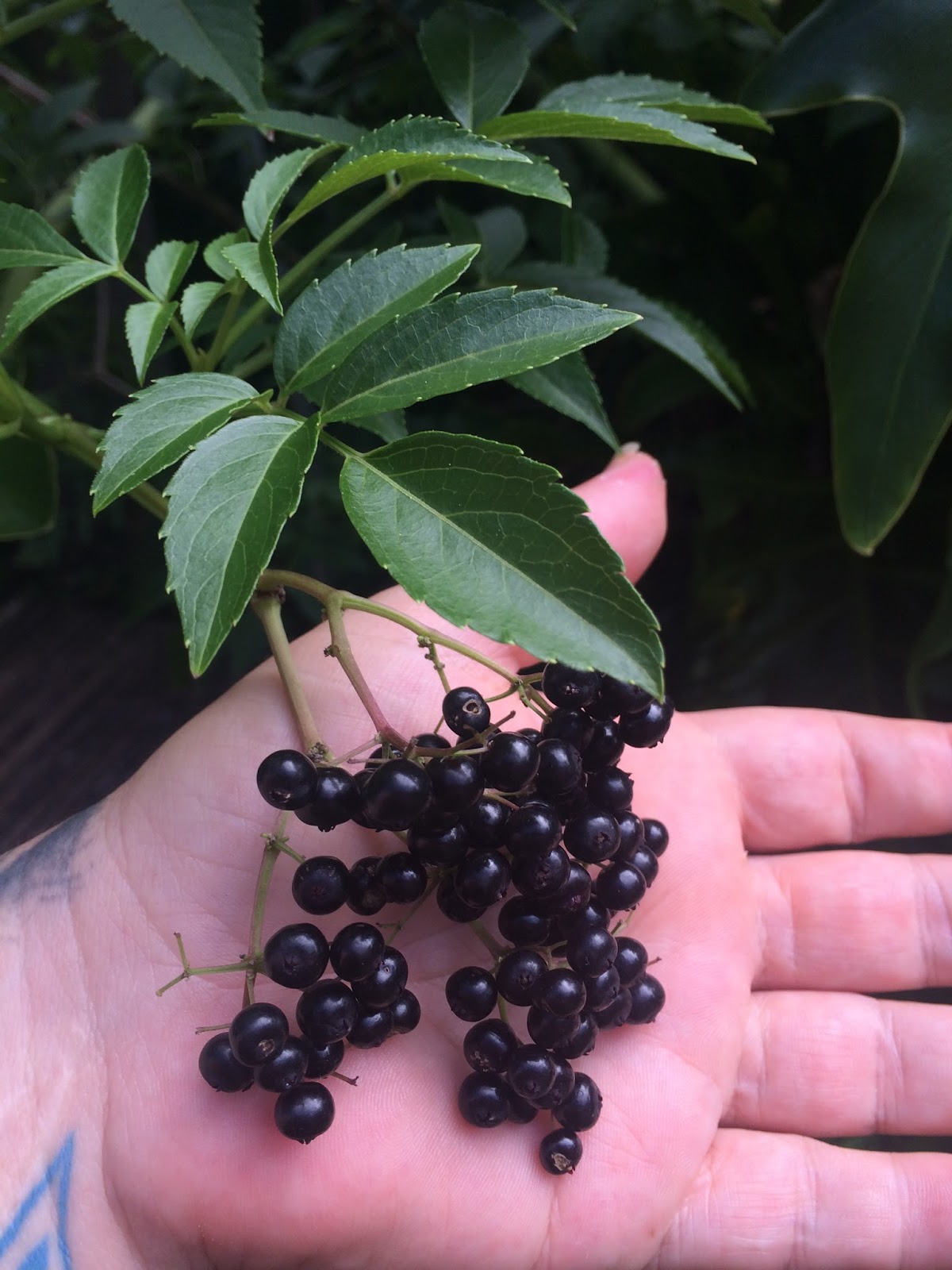
Our Elder's have born fruit for the first time! Although not enough to make wine with or tincture, I am gratefully tasting good medicine straight from her branchs as I thankfully pour a little of my apple cider onto her roots in offering. Both these plants have associations with elder women, as does the season we are moving towards, as Judith Berger evokes....

"In Denmark, it was said that a dryad called Hylde-Moer, the elder tree mother, dwelled in the branches of the tree and watched over it. If any part of the tree was cut without first beseeching the elder-mother, it was believed that she would haunt the family of those who had bypassed her consent
until what was taken was returned."


"Elder is considered the tree of transformation, guardian of the thirteenth month of the Celtic tree calendar. This month, which is three days long, contains both the end of the year, Samhain (Halloween) and the beginning of the New Year (All Soul's Day). The elder tree is home to the crone who carries many names besides Hylde-Moer: Cailleich, Hel, Queen of the Underworld, and Freya, Norse keeper of the fire. This ancient goddess of many names who resides within the elder guards the doorway between the living and spirit realm of the ancestors."
                                                                                
In Gaelic folklore there is the Cailleach, a creatrix of lonesome and somewhat frightening proportions associated with the coming of winter, spirit thereof. Her face said to be blue, woad like mayhaps, and of a single eye, oft a sign of vision into the otherworlds (my interpretations). 

There is no 'epic' for the Cailleach, although a poem or two is thought to be of her, like one from the 9th century "The Lament of the Old Woman of Beare'. She is referred to under various related names, Cailleach Beare, Cailleach Bheur, Gentle Annie, when it comes to rocky landscape, isolated locales and in reference to harsh weather conditions. Late coming winter storms,  unnavigatable whirlpools and hard frosted ground are her terrain. Inferred reflections of her barren or otherwise hostile inner world, which I find rather interesting, as an aging woman.

Not in a distant oh how intellectually fascinating kind of way, but more of a growing down, sagging indeed, is real, and with the gaining of wisdoms that time passing brings, comes feelings that ain't always pretty. I have recently been rather shocked at having several respected elder women get cantankerous with me, and its made me pull up and have a bit of a think. Now they probably are not aware of this effect, working conciously as community nurturers, which indeed they are. Protectors of the ways. The plant Nettle comes to mind. I'm not saying this means their behaviour didn't hurt.

What I am saying, and pondering, is that perhaps I have romanticised the Crone as an archetype, into particular forms, and in doing this, not allowed my friends their vulnerabilities as real folks. What is folk lore, after all, but tales of people? Is the wise woman not allowed difficult or intense emotion (at any age)? Challenges she may respond to in ways we find confronting and suitably unbecoming? Am I not, looking the Cailleach in the eye in some ways? Another translation of her name is 'veiled one', holder of mysteries and what lies beyond.

In Ireland, Wales and parts of Scotland I've read of traditions around the last sheaf of wheat being referred to as the Granny, or even Cailleac. There are connotations that the last farmer to pull in his harvest will be left with the old hag, as a sign of his procrastination, laziness even. It's an honor to be avoided. However, also, there exist traditions where a part of this sheaf is fed to the horses who plough the first field of the next season. That therein, is contained the seeds that survive the winter and feed the spring sowing. Interesting. Not in a kind of abstract that's a quaint old folk tradition type way, but the reality that older women hold seeds.

" A modern version of the Stenia ( or Bitching Festival) is when we get together and discuss our negative emotions. We pay a lot of money for these moments in therapy groups. Somehow, negative emotions are not acceptable, and we pretend we don't have them. If we are lucky and have a best friend, we can always vent these negative feelings to them. But what a joy if we could safely (my emphasis) tell off face-to-face those people we are angry with!"
                                                                                                 Z Budapest
 
Now I'm going to digress into some of my own shamanic journey work with Cailleach, it's not from a book, a blog or resources, other than my own personal ones engaging with spirit.

I had been guided to visit her several times in the cottage where she lived, on the edges of village and forest. As I turned to her, before being seated, on one visit, she suddenly turned into the most frightening spectre, and loomed above me intimidatingly. I felt completely unsafe, I was terrified! However, I stood my ground, how, I am unsure. Somehow saying, 'I know you', recalling earlier, friendlier, incarnations. She shrank back down to familiarity, 'Goooood!' she said, laughing uproariously and slapping her knee.

I hope I can conjure up this same steadfastness with the Elder women in my life who have shown me a taste of the shadow realms, and that there may be healing beyond. My beloved Grandmother Alice, told me to f*** off once. So I listened, respected her wishes, and bloody did. On my return, carrying a softer memory of her, she offered me seeds I continue to carry.


References and Resources:

'Funk and Wagnalls Standard Dictionary of Folklore, Mythology and Legend'. Harper and Row. 1970.

'Grandmother Time: A Women's Book of Celebrations, Spells, and Sacred Objects for Every Month of the Year' by Zsuzsanna Budapest.  Harper Collins, New York. 1989.

'Herbal Rituals' by Judith Berger. St Martins Press, New York.1998.

'Kindling the Celtic Spirit: Ancient Traditions to Illumine your Life Throughout the Seasons' by Mara Freeman. Harper Collins, New York. 2000. see 'Meditation: The Hag's Chair' p222.

'Tairis' blog: An article on Brigid and the Cailleach
http://www.tairis.co.uk/an-tri-naomh/bride-and-the-cailleach/

'Two Old Women: An Alaskan Legend of Betrayal, Courage and Survival' by Velma Wallis. Harper Collins. 1993. Great read for any woman feeling cast out.
Monday, January 22, 2018

Cernunnos....

          Earthing out in the shade, amidst the leaf litter and soft grasses, in the heat of the day.
                                                                 As you do....


Saturday, January 6, 2018

The Seeress....

The Seeress may appear blind to the physical realms, yet her vision both includes and moves beyond its borders. Cronewort, an Artemisia ally, assists her shifting. Here she is seen in her birthing space.

This enspirited doll has been part of an intensive process over the last two or so weeks, developing a body pattern and doll size for my new Etsy shop, Opalartifacts. She was followed by the first doll to be sturdy enough for listing, a wee Crone, also a walker between the worlds. A wise and merry guide for someone to find...


Opalartifacts shop https://www.etsy.com/shop/Opalartifacts

Wednesday, December 20, 2017

Tincturing fresh herbs...a hybrid approach.


There's something about tinctures made from fresh herbs you've grown, or wildcrafted, that generally makes for a very different sort of magic and medicine. I find there's more of the faery in it, not that I'm recommending injury to faeries in any way shape or form, but just saying, the spirit of the plant comes through. Having said that there's always exceptions to the rule isn't there?

There's a few generally accepted ways to make tinctures: the folkloric method, the weight to volume method, and percolation (which uses dried herbs).

The 'folkloric' way of tincture making, is to harvest your herb, cut it up fine with a pair of designated scissors, and then pour 100 proof ( 50% alcohol 50% water) Vodka over to cover. You need at least 40% alcohol for its preservative ability to shine through.

In Australia 100 proof Vodka is hard to come by so I make my fresh plant tinctures in a version of the folkloric way, but with the variation of using 95% grain alcohol, otherwise known as ethanol (less polite term), rather than vodka. I recommend small drop doseages of the finished tinctures, and because I'm adding the ethanol to fresh plants, which contain water, it's diluted in the process. So you ain't glugging down grain alcohol. I also tell folks they can take the drops in a little water. I could dilute the grain alcohol down I guess, even to 50 % water. Ive considered it, but I've had good results doing things the way I am. My Yarrow tincture has kept my partner and me clear of the winter lurgys for two seasons now.

I've found that using fresh plant material as if I were working with the 'weight to volume' method (where 1 gram = 1 ml), I usually get a ratio of 1:8 in my jar. That's equivalent to 1 part by weight of fresh herb, to 8 parts in volume of 'menstruum' (or fluid). The quantities usually have to be these proportions for the alcohol to cover the herb. I could blend the herb up to get the ratio closer to 1:2, but for some reason that doesn't sit right with me. Not to say its unlike pesto.

Now some may say that a ratio of 1:8, that's not enough to make decent medicines, but I've found this to be far from the truth, finding them effective, and receiving good feedback. If you work in ways similar to this, or have any relevant experiences, I'd love to hear from you.

Saturday, November 18, 2017

Home Herbalism...


                                                    my just sorted herb cupboard :)

My ways are those of the kitchen herbalist, partly because I suck at marketing, partly because I love the freedom of small scale experimentation n' brewing in my medicine makings and green witchery.


Fresh plant tinctures from the garden often brew past their allotted 6 weeks, but this does no harm. If anything I feel it makes for more potent medicines than commercial or larger scale prepared ones. The tinctures themselves can last for years, once prepared and decanted, of course smell and taste are going to be indicators. Sometimes, on the other hand I'm awaiting the potions arrival and jump its bones as soon as possible!

                                                    infusing whole dried Calendula flowers

Infused oils are crafted with love into double infused ones, because I have the time to do so. In the cooler parts of the year I may well leave these for longer than 6 weeks too, although in the heat of Summer I have a bar fridge dedicated to herbs, resulting in pretty fine quality products made using them as ingredients. Creams, salves but also the simple oils.

I am an organic processes herbalist walking my path. I come from an artsy, spirited background and am a chaotic liver (domestics came to me late in life), plants are entrenched with me. Our garden attests to this. Parsley self seeds left right and centre, popping up between Croneworts in their patch, Lavendar and Rosemary bushes vibrantly expand, Lemon Balm oozes from her pot, Lemon Myrtles are coming into bloom, a native amidst weeds, she is accompanied by Dune care plants, used to regenerate our local coast.