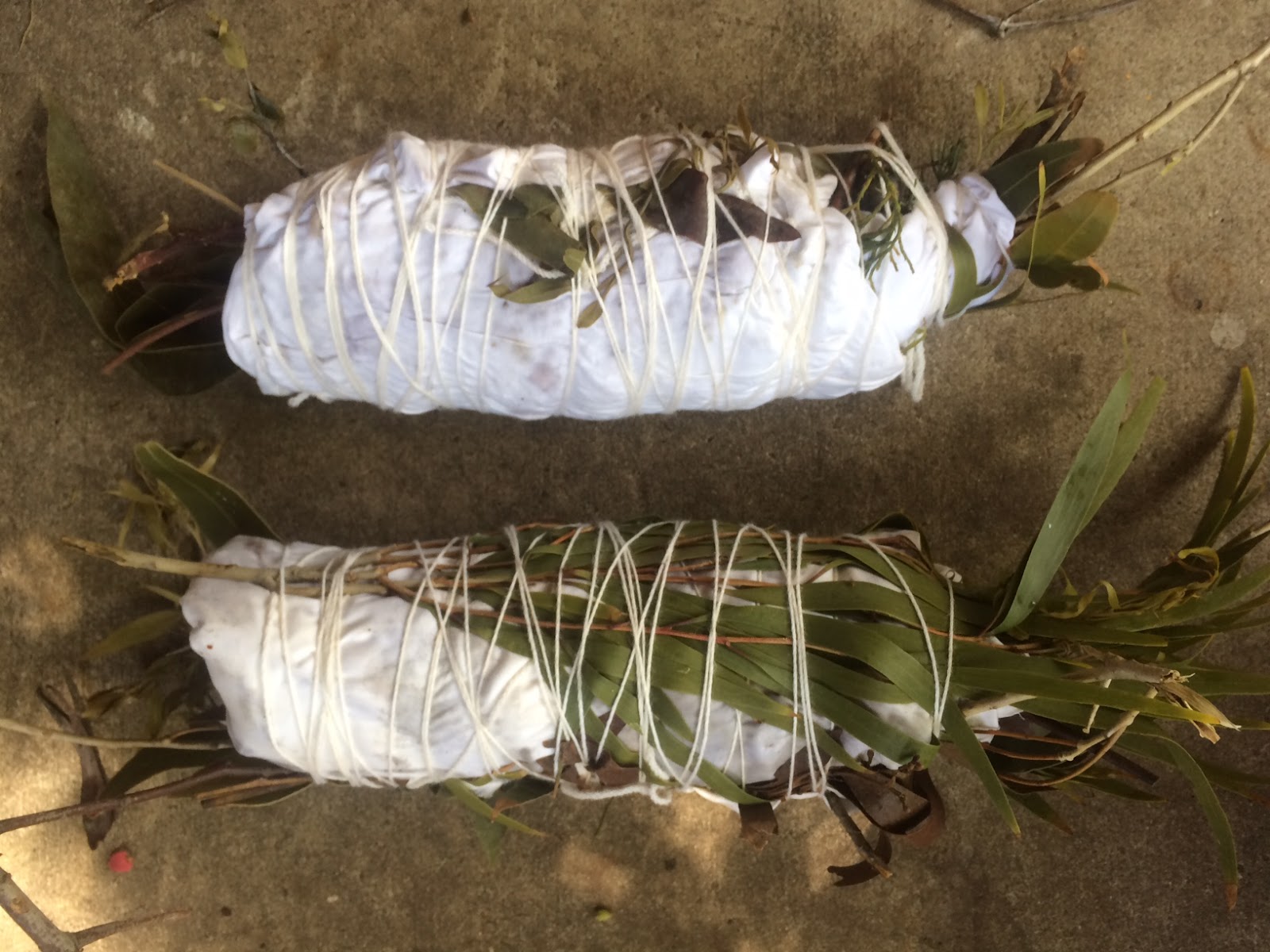
If you mayhaps read my previous post, you will have seen wordology referring to the call of gathering Scribbly Gum leaves, for L plate experiments with 'eco dyeing' cotton fabrics? Well, those leaves soaked for nigh on two weeks, and were joined by a variety of others, as the local electricity company were rather kindly trimming around their precious wires! I was terribly chaotic, no species labeling, just memory of tree n leaf shapes and locations. Then this morning I felt the time had come, aka I was busting at the seams, to try and see how things unfolded. So I lay out the variety of leaves with a sigh...
This time I had added a 'premordant' to the preparation of the fabric. Bits n bobs of rusty joy brewed away in a jar of white vinegar, which I then diluted with ordinary ol tap water, and dipped said cotton in. Allowing it to dry, n cure a whiles. I had rather pale tea like, still lovely, nothing wrong with a cup o tea, type results last time around. I was hoping the mordanting, not sure if that word exists, could deepen my colours, and mayhaps result in a leaf imprint here or there.
So I laid my mix o leaves out like an abstract painting, n bundled, to maketh ready for the cauldron, with my Spirit kin Moraig dancing a wee jig o glee beside me. So excitingk, and a wee bit ad hoc. The soundtrack was 'The Isle of Roan Inish' mixed with several disco tunes. I feel this helped proceedings.
I wasn't looking at my pot with a lid whilst folding n rolling, hence I found they were too long! Bum! However, fear not my friends, the local tip shop had regaled me with a larger one, lidless but sized perfectly! I reread my references, and decided to cover the wee wool bound rolls o magik with water n boil em, rather than steaming. See how that goes...
I added some Lichen, carefully collected and Australia posted to me by my Mum, and some Cronewort from the garden, for her sheer presence n blessings, to the water. Turned up the unwooded hearthfire and off we go journeyers! What will happen in those potently intentioned waters that smell like walking in a forest???
Oh the joy!! They worked!! Leaf prints n all. My beloved who had been wondering quietly at the buckets of soaking leaves, oohed and aaahhed appreciatively. The shots are taken when freshly unbundled, so the colours lightened some as the fabrics dried but big learning curve from my first attempt. Stoked! The skirt I dyed,which doubles as a dress has barely left my body :)....
References:
'Eco Colour: botanical dyes for beautiful textiles' by India Flint, Murdoch Books, 2008.
'Gum Leaf Alchemy: Eco printing on Cotton' by Louise Upshall, Gumnut Magic.
Showing posts with label Australian plants. Show all posts
Tuesday, November 27, 2018
Friday, November 2, 2018
Scribbly gums, scar tissue and beauty therein...
A few days ago, my beloved and I set out on foot, basket and secateurs in hand, to gather Eucalyptus leaves for my fledgling experiments with 'eco dyeing'. These words coming from the title of a book on plant dyeing I recently borrowed from the local library, by the inspiring India Flint. Specificly on colouring fabric using plants and minimal toxic mordants (fixatives). Eucalyptus species, especially those with leaves o a blueish tint, she discovered work pretty good without 'mordants' on protein fibres, like wool and silk. Of course, I chose to work with cotton! That'd be right. Ha! The tale of preparing cellulose fibre is mayhaps for another time, but began with me swimming in the ocean with 3 metres of unbleached cotton and numerous doilies from the op shop 3 weeks earlier...
Back to ambling with a basket in hand towards local bushlands. We were heading along a path into a deeper part of the Scribbly Gum forest, (so called because of the 'writing' created by small grubs under and upon the bark). I began to notice that those blueish tint leaves, were all way up high in the canopy, beyond reach. However, I recalled a patch nearby, who's form was a more scrambling nature. So we reversed, and made our wending way towards the area. We entered what is a relatively close to suburban realms place. Here the trees have had their cores burnt by bush fire several times, yet regrown around these wounds, and continued to live. In one of the holes created in a trunk by this scarring, we were greeted by a special sight....
A cluster of orchids! Beings who had found their niche, literally amid scar tissue. In a world where for us people, life requires navigating challenges, these Cryptostylis erecta, otherwise less formally known as 'Bonnet Orchids' or 'Tartan Toungue Orchids' had discovered their groove. Sprouting where ants had carried a kind of fine saw dusty soil and moisture collected, upon the dead tissue. It felt like an affirmation, a gift. Keep going you two, you never know what you'll find, or where the trail will lead!
Merrily, I collected my fresh gum leaves, some with nuts, and dried windfall from the ground. I took them home and proceeded to boil n steam up my first pieces of bundled cotton fabric, wrapped upon copper pipe. The results were fairly pale greens and browns, darker where copper touched, but I love them, because they are a start! It's a learning curve. I have some idea's of how to deepen the colours, mayhaps even get some clear leaf prints furthur along. I have rusty iron bits n bobs brewing in white vinegar in a glass jar as I type. An ' iron mordant' said to help with these processes. I am definitely on my L plates, but what delightful diversions along the journey! Seems we stumbled upon both surprise orchids, and for me, another way of engaging with the magic of plants!
Back to ambling with a basket in hand towards local bushlands. We were heading along a path into a deeper part of the Scribbly Gum forest, (so called because of the 'writing' created by small grubs under and upon the bark). I began to notice that those blueish tint leaves, were all way up high in the canopy, beyond reach. However, I recalled a patch nearby, who's form was a more scrambling nature. So we reversed, and made our wending way towards the area. We entered what is a relatively close to suburban realms place. Here the trees have had their cores burnt by bush fire several times, yet regrown around these wounds, and continued to live. In one of the holes created in a trunk by this scarring, we were greeted by a special sight....
A cluster of orchids! Beings who had found their niche, literally amid scar tissue. In a world where for us people, life requires navigating challenges, these Cryptostylis erecta, otherwise less formally known as 'Bonnet Orchids' or 'Tartan Toungue Orchids' had discovered their groove. Sprouting where ants had carried a kind of fine saw dusty soil and moisture collected, upon the dead tissue. It felt like an affirmation, a gift. Keep going you two, you never know what you'll find, or where the trail will lead!
Merrily, I collected my fresh gum leaves, some with nuts, and dried windfall from the ground. I took them home and proceeded to boil n steam up my first pieces of bundled cotton fabric, wrapped upon copper pipe. The results were fairly pale greens and browns, darker where copper touched, but I love them, because they are a start! It's a learning curve. I have some idea's of how to deepen the colours, mayhaps even get some clear leaf prints furthur along. I have rusty iron bits n bobs brewing in white vinegar in a glass jar as I type. An ' iron mordant' said to help with these processes. I am definitely on my L plates, but what delightful diversions along the journey! Seems we stumbled upon both surprise orchids, and for me, another way of engaging with the magic of plants!
Friday, June 29, 2018
Depression and Bush flower essences...
When a dear sister hit the road travelling to more southerly climes, she left her collection of Australian Bush Flower essences with me to baby sit, with the words work with them, simply replace what you use. It had been years since I had made or worked with these medicines. At the time I was in a quandry as to whether to go back onto the antidepressant medications I had not so long ago withdrawn from. I decided to try working with the essences first....
Flowers are a plants spunky bits, the pollinator attracting, reproductive part. They also speak of the plants personality, their strengths, focus and character. This is the aspect I see flower essences connecting with. Not that the whole plant doesn't hold these messages for us, indeed they do, but flower essences can touch us in unexpectedly subtle, yet potent ways, for medicines which hold little of the 'physical' constituents of a plant. Perhaps they can effect emotional and spiritual challenges, particularly where other resources may have not touched the sides. Simply because, who doesn't look at a flower with wonder, and a little fascinated awe? They contain a concentrated imprint.
Drinking the dew, or indeed nectar of flowers, is a phenomena that has been going on for as long as passers by thirsted for cool drinks. Indigenous Australians drank the nectar of bottlebrushes, dryandras, grasstrees, grevilleas, hakeas, red-devils, tea trees and wild honeysuckles. Flower heads were shaken, or soaked in water. Other flowers simply tapped across the palm of the hand and then licked. There are many tales that involve the gifts, and symbolism, of native flowers like the Waratah. Medicine ways often arise from lore, and its not such a leap to personally listen to the messages of the plants, and then hear affirmations in these tales.
Dr Edward Bach, in modern times, a homeopath and sensitive who is known for his self named flower essences, apparently acknowledged that remedies would come, following his own, for and in different places and times. This has been shown to be true, with the Californian Flower Essence Society, Findhorn Flower Essences, Australian Bush Flower and Living Essences of Western Australia, amongst many beautyfull, go you, smaller scale makers :).
Recently walking in nearby bush, a dew covered flowering Styphelia plant, waved to get my attention, and whilst noticing the unusual greenish colouration of her flowers, I pondered. Taking note of where she was growing, and with permission having a beverage stop. Later on returning home, I pulled out Ian White's, Australian Bush Flower Essences books and there she was. Named 'Five Corners' for her fruit form, relating to building self esteem, love and acceptance of self and joyousness. Hhhmmm....
When I delved into the kit I was care taking, she was missing, so my partner, Miles, and I returned to her the next day with our medicine making gear :). Me with gear, he with feet, and phone camera.
There's some good resources online about making flower essences, so I won't go into the processes here too much, except to say it's not too hard, and a lovely process. If someone says don't touch the plant, use tweezers, go ho haa, its a dialogue. That by connecting with the plant, a healing relationship forms. You can make your own medicines. Again!!
Now, I'm not saying flower essences replaced an antidepressant, they work in compleeeetteely different ways. Firstly, I had to be out and about walking to connect with Styphelia, if only just making it there. The beauty of her forms, and colours, were enough to stop me in my tracks. She got my attention, and shifted it, to asking if I could sip her dew, and indeed make some medicine, to later share with others. She helped me identity dance. Reclaim :)
Thursday, December 8, 2011
Bunya nut tree....
This is the Bunya nut tree, Araucaria bidwillii, thats at our front fence, Indigenous peoples had whole celebrations when these trees were ripe for the harvest and travelled distance to reach them, cos the nuts are damn tasty, a bit like chestnuts and also large enough to feed a crew of folks upon, each nut about 4-5cm long.
Unfortuneately for me, her leaves are also pretty distinctive aka very spikey and all over the place, especially after a couple of stormy days. Treading on them sucks bigtime. Outfront they havent been picked up for years and today in an effort to deskankyise the street front of our place I picked the residual five years or so branches up and cleared around her trunk, you know I think she quite liked the attention. It was a bit like harvesting stinging nettle, a few scrapes and scratches till I got centred and worked out a strategic angle from which to grasp them. It took about 2 hours to clear away the branches. There's actually a goodly space thats been revealed now, even some moss, and Im starting to plot on plantings. A garden bed at her base would be a skirt befitting such an honourable, and indeed naturally 'protective' tree....
Herbs face to face.....
The rain was coming down, finally, the grounds parched epidermis getting a good moisturising soak. I sat on the outside couch gazing at the garden beds and greenery. I thought to make an experiment in my calm state, looking at the plants i selected one, the maidenhair fern, and wondered if I could gauge her medicinal uses simply by listening and connecting.
I looked at her soft leaves, and the shape they hold, branching like lungs. Respiratory soother I absent mindedly pondered, soothing and soft, perhaps healer of red sore inflamed skin. I continued to gaze, then got off my butt and pulled out a medicinal plants of Australia book, just to see...
Adiantum peltatum has been used in Europe and elsewhere under the name of 'sirop de capillaire' in diseases of the chest, our common maidenhair fern the one I was sitting with, Adiantum aethiopicum, has been used for the same purpose, as an infusion of one to five parts of plant to 100 parts water. Clever plant.....
Was this how it all started, the plants teaching us experientially? Duh. There is something different in relating to a plant growing nearby you, than a dried plant part thats come a ways to get to you.Which is why localised lore is such a beautyfull way to relate to our environment, and people have worked to preserve it.
I tried the same experiment with dried celery seed, but I was off the mark. I kept getting 'nourishment', as in the goodness of homemade stocks and soups, what I read said sleep inducement, aid to divination and concentration, a sometime ingredient in flying salves. All forms of nourishment, but the informations not as accurate as with the fern.This is why I want to grow the herbs i work with, and work with the herbs I grow, to get to know them face to face...
I looked at her soft leaves, and the shape they hold, branching like lungs. Respiratory soother I absent mindedly pondered, soothing and soft, perhaps healer of red sore inflamed skin. I continued to gaze, then got off my butt and pulled out a medicinal plants of Australia book, just to see...
Adiantum peltatum has been used in Europe and elsewhere under the name of 'sirop de capillaire' in diseases of the chest, our common maidenhair fern the one I was sitting with, Adiantum aethiopicum, has been used for the same purpose, as an infusion of one to five parts of plant to 100 parts water. Clever plant.....
Was this how it all started, the plants teaching us experientially? Duh. There is something different in relating to a plant growing nearby you, than a dried plant part thats come a ways to get to you.Which is why localised lore is such a beautyfull way to relate to our environment, and people have worked to preserve it.
I tried the same experiment with dried celery seed, but I was off the mark. I kept getting 'nourishment', as in the goodness of homemade stocks and soups, what I read said sleep inducement, aid to divination and concentration, a sometime ingredient in flying salves. All forms of nourishment, but the informations not as accurate as with the fern.This is why I want to grow the herbs i work with, and work with the herbs I grow, to get to know them face to face...
Sunday, November 27, 2011
Our magical garden...
Originally I thought excitedly in our new garden space to grow some traditional witch/shamanic plants from seed, plant them out and my shady garden would be perfect for them to flourish. That wasnt the journey that eventuated a couple of months down the track when the sun shifted and the seed raising mix was still free of sproutlets....
My attempts to grow traditional plants like Henbane, Belladonna, Mandrake and also Lobelia inflata have had very disappointing results. However, whilst focusing on the Solanaceae I did discover two kinds self seeding here, Solanum nigrum, and an as yet to be identified vine with purple flowers like a tomatoe. Solanum nigrum berries are edible and the steamed leaves tasty. Perhaps the northern Australian climate just isn't condusive. A friend and I visited a local specialist nursery and they had had little luck either. I'll have to work with what occurs organically in the area, which includes Datura species. We have a white one, Brugmansia suaveolens, and Ive seen others growing locally.
The native ferns i planted out this week amidst the bromilliades and succulents are doing well. Ferns having a long history of magical and medicinal use, being some of the most ancient plants on the planet. Said to be gateways to the otherworld and realms of the fey, especially on Midsummers eve. The spores said to allow one a degree of invisability to go about daily business without attracting overt attention.

The Elderberry I planted soon after moving in as a just sprouting cutting has quadrupled in size. The Elder has such potency that the lore around harvesting its wood is detailed and comes with warnings not to offend resident dryads. Its flowers and berries are known for their medicinal wine but the bark and wood belongs to the Crone. It seems that rather than me working with the plants, again, I find it is they working with me, and that nature provides just not always what we expected.
I now have a slighly different vision for the garden here thats evolving into a more realistic assessment of soil, climate and salt air. Literal rainforest and heathland occur naturally. It will take time, energy, nutrients, suitable planting and water, but Im getting to know the potentials of the space, 6 months down the track. The outdoor area is quite big and has lots of different microcosms/ mini ecosystems, its a matter of finding plants to suit the various areas. I want to add a lot of vegetation, which was part of the reason I wanted to grow herbs from seed. :( Vegies I can do, but herbs, no joy. Not like our previous garden where I just broadcast seeds direct into the soil, watered and up they came, chamomile, echinacea, here they get fried and dried out in one hot day.
I envisage a lot of diversity, native bush flowers, tropical plants, herbs and vegies, to maximise survival and beauty. Learning what grows will be slighly experimental. I want sculptures about, and have setup an outdoor altar of an old wood fired stove. Looks like something from a fairy tale eh? That sits by the fern patch...

Yesterday i found this bench thrown out because one of its planks is broken, still has ample room for my behind and makes for comfort amongst the afternoon breezes area.
So gradually our garden is becoming, just not as expected, but after all what garden doesnt contain a little wilder magic? Like the sawn off stump thats resprouting in our front yard. When I first looked at the place there was a big ol tree but when I came to move in it had been sawn off to a stump, it was a bit of a shock really. Apparently its a weed, well we should be able to tell shortly as shes covered in regrowth. Is it a fig or a rubber tree?
My attempts to grow traditional plants like Henbane, Belladonna, Mandrake and also Lobelia inflata have had very disappointing results. However, whilst focusing on the Solanaceae I did discover two kinds self seeding here, Solanum nigrum, and an as yet to be identified vine with purple flowers like a tomatoe. Solanum nigrum berries are edible and the steamed leaves tasty. Perhaps the northern Australian climate just isn't condusive. A friend and I visited a local specialist nursery and they had had little luck either. I'll have to work with what occurs organically in the area, which includes Datura species. We have a white one, Brugmansia suaveolens, and Ive seen others growing locally.
The native ferns i planted out this week amidst the bromilliades and succulents are doing well. Ferns having a long history of magical and medicinal use, being some of the most ancient plants on the planet. Said to be gateways to the otherworld and realms of the fey, especially on Midsummers eve. The spores said to allow one a degree of invisability to go about daily business without attracting overt attention.
The Elderberry I planted soon after moving in as a just sprouting cutting has quadrupled in size. The Elder has such potency that the lore around harvesting its wood is detailed and comes with warnings not to offend resident dryads. Its flowers and berries are known for their medicinal wine but the bark and wood belongs to the Crone. It seems that rather than me working with the plants, again, I find it is they working with me, and that nature provides just not always what we expected.

I now have a slighly different vision for the garden here thats evolving into a more realistic assessment of soil, climate and salt air. Literal rainforest and heathland occur naturally. It will take time, energy, nutrients, suitable planting and water, but Im getting to know the potentials of the space, 6 months down the track. The outdoor area is quite big and has lots of different microcosms/ mini ecosystems, its a matter of finding plants to suit the various areas. I want to add a lot of vegetation, which was part of the reason I wanted to grow herbs from seed. :( Vegies I can do, but herbs, no joy. Not like our previous garden where I just broadcast seeds direct into the soil, watered and up they came, chamomile, echinacea, here they get fried and dried out in one hot day.
I envisage a lot of diversity, native bush flowers, tropical plants, herbs and vegies, to maximise survival and beauty. Learning what grows will be slighly experimental. I want sculptures about, and have setup an outdoor altar of an old wood fired stove. Looks like something from a fairy tale eh? That sits by the fern patch...

Yesterday i found this bench thrown out because one of its planks is broken, still has ample room for my behind and makes for comfort amongst the afternoon breezes area.
So gradually our garden is becoming, just not as expected, but after all what garden doesnt contain a little wilder magic? Like the sawn off stump thats resprouting in our front yard. When I first looked at the place there was a big ol tree but when I came to move in it had been sawn off to a stump, it was a bit of a shock really. Apparently its a weed, well we should be able to tell shortly as shes covered in regrowth. Is it a fig or a rubber tree?
Friday, October 7, 2011
down the bush path...
Im doing a course in 'mindfullness meditation' at the moment, which translates roughly into being present in your body and surrounds, rather than off in future or past in your head. Everyday reality and the senses. Works better for me than internal practices where my head verges on implosion. So thought Id take a nature walk in that context, when this path appeared the temptation to explore led me on...
These bansia flowers were almost hypnotic in their spiraling....their bark knobbly and warty like a toad skin...
The scribbly gums with bug created graffiti on their bark are just coming up to flowering...
A chilled wander that reminded me how cool it is to be able to step off the concrete to tread such paths at my front door. I love my home...
These bansia flowers were almost hypnotic in their spiraling....their bark knobbly and warty like a toad skin...
I don't know what it is with reptiles n me at the moment but this well camoflaged character was very cooperative, or shit scared, perhaps a bit of both, as he allowed me to take his portrait.
The scribbly gums with bug created graffiti on their bark are just coming up to flowering...
A chilled wander that reminded me how cool it is to be able to step off the concrete to tread such paths at my front door. I love my home...
Tuesday, September 13, 2011
Living in the subtropics now...
Its been a sublime day and the light on the 'look after itself'' part of the garden brings out the subtropical vibe. Those plants i nearly uprooted are glorious in their greenery and theres flower buds of an exotic tangent beginning to appear. The 'drip tips' on leaves so recognisably rainforest abound and create shadow blessed beauty.
"Observing the continual degradation of rainforest, both within and outside Australia can be so depressing that immobilisation and inertia set in. A sure antidote is getting into, observing and learning from those rainforests that are relatively safe. The forest itself provides the inspiration necessary for its protection. We encourage those who use rainforest plants in their gardens to think about and appreciate the fantastically complex ecosystems to which their delightful specimens belong."
Nan and Hugh Nicholson,
in "Australian Rainforest Plants 3". 1991.
Friday, September 9, 2011
Tea tree lake...
This morning I rose early and rode to a path Id seen off the main road, in search of a Tea Tree lake that was used by the indigenous women of this area as a birthing pool. Its been quite elusive. As i started walking into the bush I felt the stress in my body exhale out as I walked between forest, then wetlands and watched the soil change to sand as I neared the lake. Yep finally found it, amongst the paperbark trees. I sat watching the ripples on the water surface, stained brown by fallen leaves and said a prayer to the elements, offered up some tobacco.
As I got up to leave i remembered to stop, and connect with a particular plant that drew me. One caught my attention, commonly called a 'hopbush'. I pondered whether it had been used to brew ale of some form or whether she had soporiphic qualities? I greeted her and asked if I could pick a leaf. Yessss. Crushing it between my fingers the scent was strongly musty. I tasted a small amount and it had that green banana sensation to it. Many Australian native plants have strong oils in their leaves and I wondered why?
There are few leaf eaters here, so what is the oils purpose, not as defense? Or is it, like with lavendar and rosemary, that the poor soils and at times harsh climate create such potency.
Perhaps this also indicates the strong medicinal potentials of Australian plants, and the reason why indigenous medicine used 'smoking' as one of their main techniques. Placing leaves on a fire and then inhaling or passing a person through the smoke. It was also a version of incense, used to clear energy before ritual and dance.
Eucalyptus oil is world renoun for her antiseptic and disinfectant qualities, as is Tea Tree oil. There is a limited amount of information on medicinal uses of plants in parts of Australia, knowledge safe guarded by indigenous communities. I wondered of learning more through direct connection with plants met like the hopbush.
I bode farewell and kept walking...my brain started up..bugger should have brought my camera...
As I got up to leave i remembered to stop, and connect with a particular plant that drew me. One caught my attention, commonly called a 'hopbush'. I pondered whether it had been used to brew ale of some form or whether she had soporiphic qualities? I greeted her and asked if I could pick a leaf. Yessss. Crushing it between my fingers the scent was strongly musty. I tasted a small amount and it had that green banana sensation to it. Many Australian native plants have strong oils in their leaves and I wondered why?
There are few leaf eaters here, so what is the oils purpose, not as defense? Or is it, like with lavendar and rosemary, that the poor soils and at times harsh climate create such potency.
Perhaps this also indicates the strong medicinal potentials of Australian plants, and the reason why indigenous medicine used 'smoking' as one of their main techniques. Placing leaves on a fire and then inhaling or passing a person through the smoke. It was also a version of incense, used to clear energy before ritual and dance.
Eucalyptus oil is world renoun for her antiseptic and disinfectant qualities, as is Tea Tree oil. There is a limited amount of information on medicinal uses of plants in parts of Australia, knowledge safe guarded by indigenous communities. I wondered of learning more through direct connection with plants met like the hopbush.
I bode farewell and kept walking...my brain started up..bugger should have brought my camera...
Thursday, July 21, 2011
Incensed....
Picture a flaming hearthfire, on top a pot bubbles away with a soup, or stew, or stir fry flavoured with herbs and spices. Smoke from the fire is mixing and blending with the scents of cooking, slightly tinged with the particular tree who gave of their wood to this scene. Perhaps some bread is baking, to dip into the meal. This picture is taking place all over the world, the localised herbs and spices varying what hungry noses are tempted by. What we are observing is highly likely the origin of incense...
Plants, and the scents they release when burned, have inspired, blessed, healed and comforted for eons. Be their form chunks of sap, branches or leaves straight from a tree, or the more processed mixtures of dried and powdered herbs burnt on charcoal, bound to a stick or swung in censors.
A newborn baby is held over a small fire, laced with leaves, be they spinifex or eucalypt, depending on what grows nearby, there is a blessing and welcoming into her new environment by passing through the smoke. A connecting to plants, and the hearth. For who is the bridge between earth and animals, even human ones, if not plants, it’s been thus since we were pondscum feeding on algae.
On the other side of the planet sage is rolled into a stick, bound in thread and allowed to dry like this, to be later lit and used to ‘smudge’ before a ritual dance, ceremony, or soul retrieval. The smoke brushed around the body using a cluster of eagle wingtip feathers it curls into where its needed, then rises high into the sky, and upper realms of spirit.
Incenses origins often reside in resins and barks. Sandalwood is so desired, that all the trees in Mysore, the place it occurs naturally are government property wherever they occur, and harvesting is watched over. There is also an Australian sandalwood, Santalam acuminatum, a interior species thats being used similarly as an alternative. The seeds of which were traditionally made into necklaces, not unlike the ones in india that saddhu’s wear and consider holy. They look like small round brains, interestingly enough considering the sacredness of them.
With such deep ancestral memories and associations is it any wonder that incense has been adopted by nearly every kind of faith, including atheism, on the planet. A precursor and codeveloper with perfume and aromatherapy, varying scent to mood and occasion. How blessed are we to have such a tool for shifting consciousness at our fingertips? It doesn’t have to be expensive, with a charcoal block any mix of dried herbs can be sprinkled on and encouraged to share its smoke.
Home feeling a bit stagnant? Setting a romantic or meditative scene? Taking a luxurious bath, got a candle going? Bit blue? Why not light up?
Thursday, May 26, 2011
We have to admit that the language, in vegetation, of the land has been altered in many waves of plant arrivals, each changing the character of what grows in a certain place. Some species have adapted so well as to overtake and force out others. How do you choose what to keep or pull out in your garden, or on your land? Its a matter of perspective, and i would suggest a process in action that contains its own paradoxes. Lantana for example, recognised as a hideous invasive force in bushland, was originally brought into the country because it formed hedges with clusters of pretty flowers. Forms hedges alright, sometimes metres high along creeklines. In one context, gardens, it worked for a while, but when it busted out of context, it dominated. Yet even while doing so, provided its delectible berries to native birds. Its thicket like form created nesting sites in situations where other habitat may have been destroyed. Vegetation is often an evolving, rather than a static thing, and may well depend on who is caretaking a site, or not, as to how it develops and changes.
Certainly since the coming of white boatpeople to Australias shores plants travelled with them, have taken root and flourished. With furthur layers of folks coming from all over the world (some of who would have been happy to find plants like dandelion growing in their new home) came different plants, some of which naturalised.
"these weeds are now part of a 'new' Australian ecology."
Greg Czechura, Queensland Museum
As someone looking for medicines and food to harvest, also just blown away by natures diversity, I hope my senses are open to all kinds of plants. The pictures above of red clover and a waratah each hold beauty for me, amazingly similar in their form though originating on oppposite sides of the globe...
Resources:
Robin Buchanon. 'Bush Regeneration'.
Tim Low. ' The New Nature: Winners and Losers in Wild Australia'.
Suzanne Ermert. ' Gardener's Companion to Weeds'.
Tuesday, May 24, 2011
red clover, white clover...
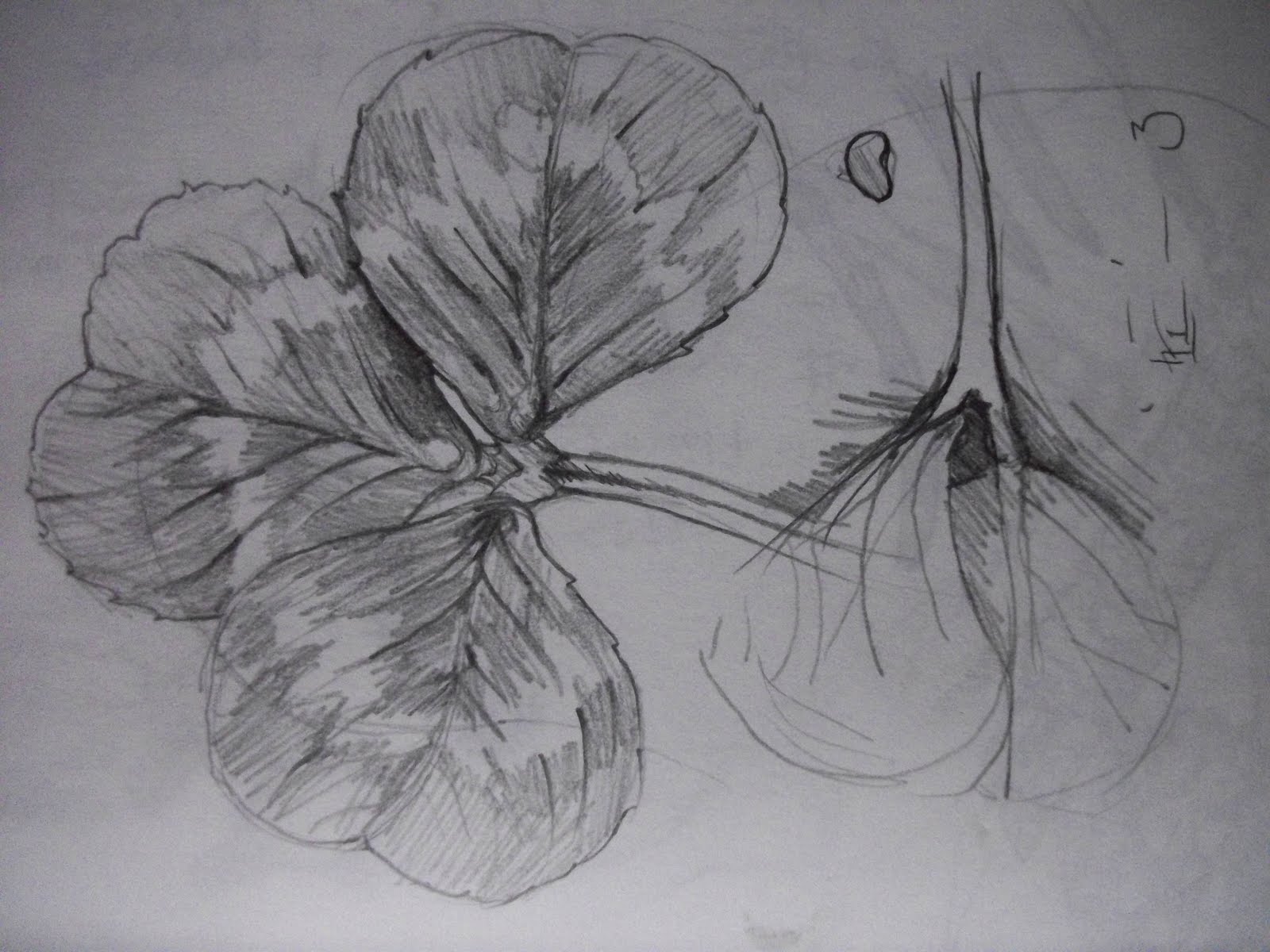
Both from the same family, Red Clover, Trifolium pratense, is the one most often used in healing but in Australia, White Clover, Trifolium repens, seems far more common. As far as I know they have similar properties but the white clover is much milder in its effects. These sketches are of white clover found growing in a lawn.....
Thursday, May 19, 2011
Australian Native Plants, some potent forces....
Traditions of bush food, and medicines, are passed on orally as an adjunct to learning the landscape here, and this has in places been undeniably fragmented by colonisation, but reweaving is and has been going on. Records kept in a written culture are expanding as Indigenous communities speak for themselves, teach and create educational syllabus. These are a good source of learning for those of us with an interest, and provide a continuity different to the documents of early voyages and expeditions from Europee.
A crucial part of knowing what you can eat or make medicines is often in how to prepare them and that applies everywhere. For example, the ‘cycad palm’ seeds that look so delectable, (Australia has 28 species) all require extensive processing. Be that baking in coals for an hour and then soaking in water for 6 to ten days, or roasting, pounding and then soaking in water for two weeks. A plant like the bunya-bunya pine has large tasty nuts which simply require boiling and then peeling off of the outer husk to reveal a nutty treat. The macadamia nut is a low preparation nut by comparison. Its a question of getting to know the plants and doing some research. They sit at different points along a sliding scale of preparation required to maximise nourishment and minimise harm.
Perhaps being some of the most ancient species on the planet some species feel they’ve done their time as food and medicine.The women who did most of the gathering had to be skilled botanists. Plant food sources were up to 80% of the diet in desert areas, down to about 40% on the coast
Fruits seem to be some of the more approachable bushfoods. Some , like those of the lilly pilly, Syzygium species, are now commonly available in nurserys.
Perhaps being some of the most ancient species on the planet some species feel they’ve done their time as food and medicine.The women who did most of the gathering had to be skilled botanists. Plant food sources were up to 80% of the diet in desert areas, down to about 40% on the coast
Fruits seem to be some of the more approachable bushfoods. Some , like those of the lilly pilly, Syzygium species, are now commonly available in nurserys.
I would like to talk about pigface, Carpobrotus rossii, so named because of the fruits ‘snout and ears’. If you get coastal in your travels you would probably recognise her. Vibrant pink flowers and succulent leaves trail along the sand. The fruits redden as they reach maturity and when ripe you pick em and simply squeeze the fruit out of its skin and into your mouth. They taste almost like a salty kiwifruit.
"In the early days in this big wide open country, there was always healing cures here on the Land -the healing songs, fat, paintings and the healers - and its still the same now, even after all the old-time elders have passed on."
Veronica Perrurle Dobson, Arrernte traditional healer, 2007
Medicines are invaluable to identity and community health, sharing them is a gift and harvesting while also maintaining a plant poulation is a skill. For example, a plant may be slow growing and hence not recover easily from too large a harvest, some tubers or roots when pulled thats it for that individual plants life cycle but if you break a small piece off and replant itm thatll shoot . So if you want to nourish a patch, learn about how it grows over time and keep an eye out for its health. Itll be appreciated and thats a nice vibe....
Different preparation techniques which could be used in creating medicines, as in other traditions, include ointments made with animal fat, poultices, 'kino' (dried sap) and 'smoking' or inhalations. Smoking can be used both medicinally, and ceremonially. A small fire is lit and the leaves put on, usually picked from plants high in essential oils like eucalypts, and tea tree, Melaleuca alternifolia. Their ability in the treatment of colds and flus, or as an antibacterial to prevent infection has led to the essential oils from them being used globally. These can burn the skin neat, and are best used diluted.
The vegetation of Australia is so varied that theres much to be learned. But I did just want to write something to acknowledge the potency of some Australian native plants and the skills required to 'live on the land', as a follow up to the previous post.
Resources:
Veronica Perrurle Dobson. 'Arrente Traditional Healing'.
Institute for Aboriginal Development. 'Punu: Yankunytjatjara Plant Use'.
Minmia. 'Under the Quandong Tree'.
Peter Latz. 'Pocket Bushtucker'.
Tim Low. 'Wild Food Plants of Australia' and 'Wild Herbs of Australia and New Zealand'.
E.V. Lassak and T. McCarthy. 'Australian Medicinal Plants'.
Compiled by Michael Richardson. 'Your Own Resources: A Practical Guide for Self Supporting People in Australia'.
Different preparation techniques which could be used in creating medicines, as in other traditions, include ointments made with animal fat, poultices, 'kino' (dried sap) and 'smoking' or inhalations. Smoking can be used both medicinally, and ceremonially. A small fire is lit and the leaves put on, usually picked from plants high in essential oils like eucalypts, and tea tree, Melaleuca alternifolia. Their ability in the treatment of colds and flus, or as an antibacterial to prevent infection has led to the essential oils from them being used globally. These can burn the skin neat, and are best used diluted.
The vegetation of Australia is so varied that theres much to be learned. But I did just want to write something to acknowledge the potency of some Australian native plants and the skills required to 'live on the land', as a follow up to the previous post.
Resources:
Veronica Perrurle Dobson. 'Arrente Traditional Healing'.
Institute for Aboriginal Development. 'Punu: Yankunytjatjara Plant Use'.
Minmia. 'Under the Quandong Tree'.
Peter Latz. 'Pocket Bushtucker'.
Tim Low. 'Wild Food Plants of Australia' and 'Wild Herbs of Australia and New Zealand'.
E.V. Lassak and T. McCarthy. 'Australian Medicinal Plants'.
Compiled by Michael Richardson. 'Your Own Resources: A Practical Guide for Self Supporting People in Australia'.
Subscribe to:
Posts (Atom)