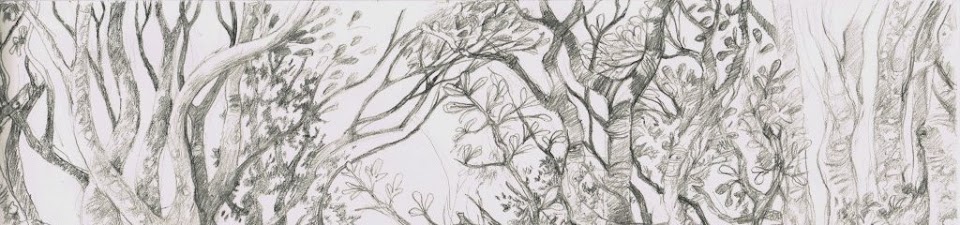
Earthwitchery, for me, evokes a practising of magic not of a high nature, but down and dirty, literally. Some may call it the Wise Woman Way, or being a Green Witch. An appreciation of the magics of compost, of gathering and growing things, of divination in the form of animals who cross our paths, of trance journeying, of brewing and ointments, crafting with intention, simple ritual, direct participation with nature, and learning to relate to the spirit in all things. Ways to nurture the Earth, and honour deity, acknowledging the aliveness, intelligence and wisdom of the green.
There is a kind of deeper quiet stillness that comes from being present with nature that poets and bards immortalise. Not that she is still herself, in fact her motions, seasons and tides are guaranteed to change and shift beneath our feet and around us. No stasis there...
Her body is my body is her body is my body as she heals I heal as I heal she heals her body is my body is her body is my body as she heals I heal as I heal she heals
Compost that’s going to break down without smelling baaad is a bit of an artform. It depends what goes into it, but if it’s going well, it smells sweet like leaf litter on forest floor and evokes all sorts of primeval ancestral recall. Earthwitchery is a bit the same for me, it feels like remembering. It’s a sensual bodily engaged experience. Give me scents, sounds and visuals through which to enhance relating to the world. The symbology of plants, animals and stones....
Plants have been with us for hundreds of thousands of years, feeding us, altering consciousness, healing and giving solace to the soul. Placed in Neanderthal graves have been found herbs still in use today, like yarrow. Every place on the Earth has its own knowledge and stories of local plant use. These, blended with personal experience offer a rich tapestry from which to draw. Much as some forces have tried to destroy such information, it persists. The earth witch works to stitch such pieces together, in her own unique way.
Wild crafting, and general scavenging for supplies, rock my world. My favourite medicines have been made from wild crafted herbs. Where I can approach a plant personally ask its permission to harvest, leave an offering as thanks, and know the place it’s come from. Although, I just brewed up an experimental batch of dandelion beer from store bought dried herbs, and that was also pretty satisfying. Any work, or play, with plants where you add energy into the mix creates feelings of integration. Through processing herbs into infusions, teas, tinctures, oils, incense, vinegars, beers or wines, we bring out their strengths and learn their talents.
“One great bonus of hedgerow cookery for me is the excuse to walk through peacefull, unspoiled countryside at my own pace, in my own time, exploring and discovering food plants in their natural habitat: what a world away from the bustle of shopping – and it has given a goal to a country walk. The sense of triumphant achievement as I come home laden with my unusual harvest of new fruits or vegetables to try out is unmatched- and season after season I still find it so.”
Rosamond Richardson in Hedgerow Cookery
“In the early days in this big wide open country, there was always healing cures here on the Land – the healing songs, fat, paintings and the healers- and its still the same now, even after all the old-time elders have passed on. The Land still has that power. The healing belongs to the country where it originated from, and belongs to the people of that country.”
Veronica Perrurle Dobson in Arrente Traditional Healing
Even traditional hunter gatherers encourage the growth of favoured plants through practices such as fire regimes and spreading seed. It’s in our genes, and there’s something about tending to a garden, or wild place, that joins us when we caretake a plot, creating sanctuary for nature spirits and recognising sacred places. We become observant of change, and encouraging of growth, although decay will follow. Tis the way of life. Such things are marked, and given their honouring times, shadows not denied, but included as allies. Seasonal festivals and celebrations echo the cycles of life, death and rebirth that every life contains.
“What is needed, once you know about the timing, is to prepare a space for your own reception of the energies that are available. Give yourself time to dream and remember, allow some space for reflection and observation, stay awake! Whatever happens in your life at these particular times is oracular- it tells or shows you something. It presents you with messages, signs, and omens about your life.. Big dreams are likely to occur now, as well as other unusual psychic events. Synchronistic and magical happenings are possible, meetings with important others in your life, and so on”
Vicki Noble
I don’t partake internally of entheogens. I do try to grow and am fascinated by some of the source plants, especially the Solanaceae, or Banes, and I am partial to a beverage, or three. I choose repetitive rhythm to shift into trance in circle. This is the landscape where deity comes alive for me, becoming three dimensional, and the direct experience of information helps practices evolve and touch base. In such states, receiving nonlinear clues that broaden horizons becomes possible, often practically applicable, and connected by a sturdy thread to daily reality and life.
“Among the living today, we stand towards trance much as we stood in relation to electricity more than ninety years ago before Edison invented the electric light bulb. Just as it might have been thought ‘imaginative’ in those days to speculate on the possible uses to which electricity might be put in our lifetime, so it will be thought ‘imaginative’ if we now speculate on the potential uses of trance to mankind....”
‘Trances’ by Stewart Wavell, Audrey Butt and Nina Epton.
“In the beginning of all things, wisdom and knowledge were with the animals for the Creator, the one above, did not speak directly to man.”
Chief Letakots-Lesa (Pawnee)
The symbology of animals connects us to their traits and habits. Observing what animals are present in our surroundings can be like a form of divination, a message to translate in discovering what the teachings of a given species are. A certain animal may be present so much in your journey that they become totemic. You may find your path crossed by a dead animal, or part of an animal, which hold its messages and reflects them back to you. Coming upon feathers, claws, wings, bones, skulls, fur and such can be seen as a call from the animal.
“All of the animals I have artifacts of are animals who have taught me something- through observation of their behaviour and spending time being close to their DNA. I certainly find that wearing feathers, holding bones, meditating with bones and things like that, helps me to gain more insight. I feel that at some level an animal’s DNA has its vibratory rate, like everything else in the universe, and by holding that artefact you can actually tune into that vibratory rate and see things from the animal’s perspective.”
Andy Baggot
All cultures and all people make, including materials that have personal significance enhances these processes. Crafting with intention is a beauty filled thing, in fact, to some degree the one can not exist without the other. Simply in deciding to make something, a certain amount of directed focus is born. Getting lost in the process of creating a piece by hand is quite trancelike or meditational, and very satisfying. To make and decorate tools to be used in ritual, or everyday objects that remind us of our paths, gives them a feel that store bought just can’t compare to, although there are craftspeople selling their own work too.
Ritual practice is a crafted way to connect with the realms beyond daily living, yet behind and part of it at all times. Although, as a solitary, it’s been a steep learning curve to find some direction, keeping it simple helps. An altar is an important centrepiece, often containing natural forms and found objects displayed for the pleasure of deity and spirit. It can give visual triggers and associations to aid shifting into sacred space... reminders and cues. As in other areas, I love to work with what I’ve managed to gather, or draw in, organically and that tends to require making do, or ad libbing.
There is much to be learned for this apprentice to Earth Witchery, but the journey has definitely begun....
Some Resources:
‘The Secret Teachings of Plants: The Intelligence of The Heart in The Direct Perception of Nature’ and ‘Sacred and Herbal Healing Beers’ by Stephen Harrod Buhner
‘Healing Wise: A Wise Woman Herbal’ by Susun Weed
‘Animal Speak: The Spiritual and Magical Powers of Creatures Great and Small’ by Ted Andrews
‘Animal Dreaming: The Symbolic and Spiritual Language of the Australasian Animals’ by Scott Alexander King
‘Voices from the Earth: Practical Shamanism’ by Nicholas Wood
‘Shamanic Voices: A Survey of Visionary Narratives’ collected by Joan Halifax PhD


